 Navigation

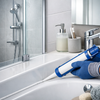
Best Sealant for Bathrooms & Showers
5 min reading time
5 min reading time
Bathrooms and showers are some of the harshest environments for sealants. Constant moisture, temperature changes, poor ventilation, and regular cleaning chemicals mean the wrong product can fail quickly — leading to mould, water ingress, and expensive rework.
In this guide, we’ll explain what makes a good bathroom sealant, how mould-resistant silicones really work, and which types of sealant professionals trust for long-lasting results.
Bathrooms combine several factors that are challenging for standard sealants:
Persistent moisture and condensation
Frequent temperature changes (hot showers → cold rooms)
Smooth, non-porous surfaces (ceramic, glass, acrylic)
Regular exposure to cleaning chemicals
A general-purpose sealant may look fine at first but often fails within months. For wet areas, sanitary-grade silicone sealants are essential.
Mould-resistant sealants don’t prevent mould forever — but they significantly slow growth by using built-in fungicides.
Fungicides are embedded in the silicone formulation
They resist black mould and mildew growth
Effectiveness depends on correct application and ventilation
No sealant is truly “mould-proof” forever
High-quality sanitary silicones typically outperform cheaper alternatives by years, not months.
✔ Fully waterproof
✔ Highly flexible
✔ Excellent adhesion to tiles, glass, ceramics, acrylic
✔ Long service life
✖ Not waterproof
✖ Cracks under movement
✖ Poor long-term durability
✔ Strong adhesion
✔ Paintable
✖ Often less mould-resistant than true silicone
Verdict:
For showers, baths, basins, and wet zones — sanitary silicone is the gold standard.
Higher flexibility
Better for joints with movement
Ideal for shower trays and baths
Firmer finish
Better for tight, rigid joints
Often preferred for vertical tile lines
Most professional installers choose low modulus sanitary silicone for baths and shower trays due to movement accommodation.
A good bathroom sealant must bond reliably to:
Ceramic & porcelain tiles
Glass & mirrors
Acrylic and fibreglass trays
Enamelled steel baths
Aluminium and stainless steel
Sanitary silicones are specifically designed for non-porous surfaces, making them ideal for modern bathrooms.
Cause: Poor ventilation or low-grade silicone
Fix: Use a premium sanitary silicone and ensure airflow
Cause: Poor surface preparation
Fix: Clean thoroughly and remove all old residue
Cause: Using rigid or paintable sealants
Fix: Use flexible silicone designed for wet areas
Remove all old sealant completely
Clean with a suitable solvent or alcohol cleaner
Ensure surfaces are dry and dust-free
Mask edges for a clean finish
Apply a consistent bead of silicone
Tool immediately using a profiling tool or soapy water
Remove masking tape before skin forms
Correct installation is just as important as the product itself.
Higher fungicide content
Better adhesion consistency
Longer service life
Trusted by professional installers
Often cheaper
Lower fungicide loading
May require more frequent replacement
If longevity matters — especially in rental properties or commercial bathrooms — trade-grade sanitary silicone pays for itself.
White: Clean, classic look — shows mould sooner
Clear: Subtle finish — hides early staining
Colour-matched: Ideal for modern tile designs
Performance is generally identical; choice is aesthetic.
For bathrooms and showers, the best sealant will always be:
✔ A sanitary-grade silicone
✔ Proven mould-resistant formulation
✔ Suitable for non-porous surfaces
✔ Flexible enough to handle movement
✔ Applied correctly to a clean, dry joint
Cutting corners on sealant is one of the most common causes of bathroom failure — and one of the easiest to avoid.

Dowsil 895 vs Sika SG-500: Which Structural Silicone Is Best? SEO Title: Dowsil 895 vs Sika SG-500 | Structural Silicone Comparison Meta Descriptio...

Silicone sealant is designed to provide a flexible, waterproof, and long-lasting seal — but when applied incorrectly, it can fail far sooner than e...

If you’ve ever checked a sealant datasheet, you’ve almost certainly seen the term “movement accommodation” — often shown as a percentage such as ±2...